
How often has a writer’s work so captured your attention that you set out to read everything they have written? With a prolific writer like master world-builder Ursula K. LeGuin, you would be embarking on quite an adventure.
As LeGuin said in her essay “Staying Awake”: “If a book told you something when you were fifteen, it will tell it to you again when you’re fifty, though you may understand it so differently that it seems you’re reading a whole new book.” So you need to read the most intriguing books again, discovering new lush futures, and wondering what makes this story resonate beyond the past it was written in.
Have you ever fallen so deeply under a remarkable writer’s spell that you wanted to learn more about them personally, even visiting the places they lived or worked, seeking to more fully understand and inhabit the enchanting works they created? Perhaps a Classical Pursuits trip has given you that gift.
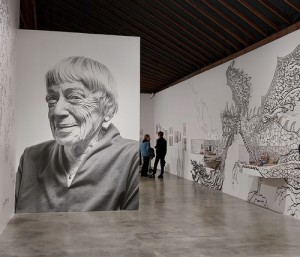
If you know what I mean, you may understand why I recently flew from Chicago to Portland, Oregon, for the final weekend of “A Larger Reality,” a well-attended exhibit on Ursula LeGuin’s life and work. The rich tapestry of possibility that makes her worlds so alive, and the serious political, ecological, and philosophical questions she raises, have long garnered her many awards and admirers.
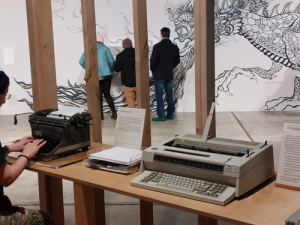
I loved seeing artifacts from her childhood, the sci-fi magazine to which she sent her first story, plus her manual and electric typewriters. Most of all, I reveled in visiting the space at the Oregon Contemporary filled with fellow readers, young and old, whose lives had been shaped by the artful, inspiring words LeGuin shared in over fifty books of fiction, poetry, and essays.
Imagine how difficult it was to recommend just one of LeGuin’s brilliant speculative / science fiction novels when we started our planning for this summer’s Toronto Pursuits seminar, Becoming Other: The Lens of Science Fiction. We ultimately chose one from later in her career — The Telling — a book with a strong female character that speaks to a milieu beyond the time she was writing in, a book that exquisitely captures the intermingling of real / imagined pasts, presents, and futures for which she was known.
All the works we selected for Toronto Pursuits, are in the same vein; raising big questions, in this case about how humans, and especially science fiction writers, shape the future, playing with time and perspective, to give readers new insights into who we think we are and into those we consider “others.” We wanted works that would appeal whether someone was a lifelong fan or tended to think science fiction wasn’t their style. We didn’t want just greatest hits, but rather examples of outstanding writing that share genre conventions (as those might be worth exploring too!).
So for July at Toronto Pursuits, Becoming Other: The Lens of Science Fiction, we’ve lined up an ancient text about a trip into space from the Roman satirist Lucien, then added an unforgettable story about the impact of technology by 19th-century writer E.M. Forster. We’ve included classics from the mid-20th century heyday of sci-fi like Clifford Simak and the intriguing novel Solaris by Stanislaw Lem. And we’re excited to discuss LeGuin’s The Telling (2000), along with short texts by Octavia Butler and Ted Chiang, to take our exploration into the current century and beyond.
We hope you will join us as we journey with these extraordinary writers who let us escape into fascinating imaginative worlds, all while allowing us to grapple with those big “What if?” questions about who we are and have been as humans, and who we are becoming. As present reality continually shifts, what better way is there to be ready for the future?
— Denise
Image credits: All images by the author, Denise Ahlquist