
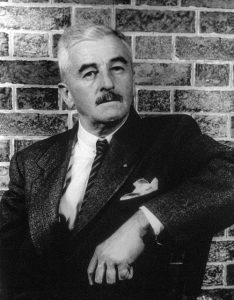
One of the literary programs at my library is what we call Author Studies, where we read all or a large portion of a writer’s catalogue chronologically. Last year featured the works of William Faulkner, beginning with his breakout novel The Sound and the Fury.
Faulkner wrote three novels that were not well received. After deciding that he was in effect, unpublishable, he decided to write the novel he wanted to write rather than write for publishers. That novel became The Sound and the Fury, his greatest masterpiece and set off a period of brilliant output, which included As I Lay Dying, Sanctuary, Light in August, and the phenomenal Absalom, Absalom!.
Reading The Sound and the Fury is the introduction to Faulkner’s heterocosm, the imaginary county of Yoknapatawpha. Yoknapatawpha and its fictional seat, Jefferson, stand in for the real-life Lafayette County and Faulkner’s own hometown of Oxford, Mississippi. Almost all of his novels and more than 50 of his stories are set here. One of the most famous of these, The Sound and the Fury is the story of the Compson family of Southern aristocrats who are falling into decline. Their story is told via four interwoven perspectives, each of which we’ll examine deeply. For Faulkner, “To understand the world, you must first understand a place like Mississippi.”
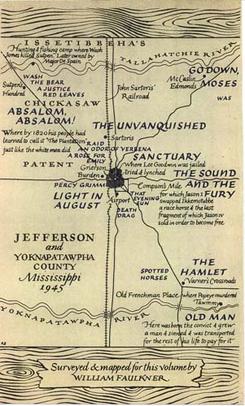
Malcolm Cowley, the legendary editor at Viking who championed Faulkner and revitalized his literary career, had this to say about Yoknapatawpha:
“All of his books in the Yoknapatawpha cycle are part of the same pattern, it is this pattern, and not the printed volumes in which part of it is recorded, that is Faulkner’s real achievement. Its existence helps to explain one feature of his work; that each novel, each long or short story seems to reveal more than it states explicitly and to have a subject bigger than itself. All the separate works are like blocks of marble from the same quarry: they show the veins and faults of the mother rock. Or else to use a rather strained figure – they are like wooden planks that were cut, not from a log, but from a still living tree. The planks are planed and chiseled into their final shapes, but the tree itself heals over the wound and continues to grow.”
Along with Harper Lee, Carson McCullers, and Flannery O’Connor, Faulkner is representative of gothic Southern literature. Faulkner was both ahead of his time but also a product of it, as he grappled with his own complicated relationship to racial issues.
Despite this, he chose to portray the South with truth, honesty, and emotion, which made him unpopular in Oxford. However, Faulkner is read and revered all over the world because the insights he brings out of the Deep South apply universally to all places, all people, and all time. It is natural and inevitable that he would be embraced across the world by countries struggling with similar societal issues. Faulkner’s global influence is unparalleled. He remains one of the most enduring and influential of the 20th-century American writers.
Known for its complex language, The Sound and the Fury is far more accessible than you might think—especially when working with other readers to clarify your understanding and build on each other’s interpretations.
Stream of consciousness, disorienting viewpoints, nonlinear storytelling, and sentences packed with sound and sense require patience to move through. Faulkner invites us to make peace with confusion, disorientation, and frustration. As you work with your fellow readers, you’ll understand that frustration can be a sign of growth, discomfort can precede ease, and confusion may pave the way to clarity and insight. That narrative style that initially seemed to be a barrier to understanding the story becomes an integral part of it. The novel is demanding, yes, but enormously rewarding as well.
Prepare to be seduced by his sublime prose poetry, intoxicating language, and profound philosophical ideas that will keep you engaged and captivated.
At Toronto Pursuits 2026 we will immerse ourselves in a slow, deliberate, and careful reading of The Sound and the Fury and will get to know each member of the Compson family and their relationship to the legacy of the American South.
You don’t read Faulkner, you reread Faulkner. Join me to embark on this exciting project at Toronto Pursuits this July.
— Lillian
Lillian Dabney is a librarian and discussion leader at Folio: The Seattle Athenaeum and a longtime attendee of Toronto Pursuits. Her career has spanned all aspects of book creation, production, and reading.
Image credits: Gradesaver.com/Wikimedia Commmons

[Note from Classical Pursuits director Melanie: We’re having trouble with our comment functioning, so I’m including here a comment sent from a participant at one of Lillian’s Seattle Athaeneum programs]: “”This is such a beautiful way to describe the challenge and joy of reading Faulkner. As a member of Lillian Dabney’s Faulkner author study, I can attest to the resounding and long lasting rewards of engaging in community with The Sound and the Fury. Lillian is a seasoned and expert guide in facilitating engaging literary discussions. All my life I had been intimidated by the idea of this particular book. Because of Lillian’s approach and her invitation to welcome the confusion and difficulty, I finally read it and found so much to love and appreciate. As soon as I finished The Sound and the Fury, I began it all over again before reading eight more of his novels.”