
This is the first of a three-part series on our favourite writing cafés in Paris.

My daily routine in Paris relies heavily on the café. I write, read, and I meet friends and colleagues there. As some of you know, I especially love the literary café history of Paris, and this coming October, I’ll be leading a tour + writing workshop that explores the creative energy that comes from working in such inspiring Parisian places.
For my first favourite writing café, I want to start at the unlikely high-end café which really came to my rescue back in 1989. This is Café Beaubourg, which overlooks the piazza in front of the Centre Pompidou and is open for business while the museum is being renovated. Café Beaubourg opened in 1987, designed by the trendy Christian de Portzamparc. In 1994, this architect won the prestigious Pritzker Prize. He was only 50 years old at the time! His buildings, for me, are often a little too much like sculptures—cool-looking, but impractical. However, his Café Beaubourg design is fantastic, functional, and fashionable, still going strong after nearly 40 years.
I first walked in one day in 1989, when I was job-hunting. I had gotten caught by a rainstorm, so I was cold and wet. My interview-ready shoes were ruined. I sat down, literally dripping with rain. I could not have looked more bedraggled. A black-suited waiter brought me a linen napkin to dry my face. To my surprise, the tony staff didn’t give me any attitude while I warmed up. If anything, they seemed sympathetic, with no interest in rushing me back outside. I ordered a hot chocolate and gradually relaxed. I read my slightly-damp book. (I was working my way through a second-hand Penguin paperback of Dante’s Inferno at the time.)
I spent a fair amount of time that first afternoon sipping my chocolate and people-watching, because back in those days, everything opened by the Costes brothers was an instant model magnet. So, there were a lot of tall skinny dames cat-walking up to the second floor to pick at expensive food. But there were also academics carrying manuscripts and politicos shaking their heads at the newspapers (which are still provided daily by the café, even in today’s digital era). There were art critics gossiping about the curatorial decisions being made at the Centre Pompidou, alongside all kinds of visitors to the city. I enjoyed overhearing snippets of Japanese and Polish and English mingling with the French being spoken around me.
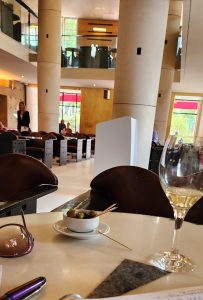
I find that cafés allow me to think more carefully about language, listening to its patterns and sounds, whether or not I understand the words. Some aspect of my writing brain works best when surrounded by people talking.
Back in 1989, I paid for my hot chocolate in francs, because this was long before the euro. The hot chocolate at the Café Beaubourg was expensive, but it came in its own little tin pot, and I spent a solid three hours in the café, reading and writing and thinking. I felt it was well worth the price. Since then, I’ve been to the Café Beaubourg countless times. Over the years, I’ve written many of my daily poems here, and I’ve also read a lot of books here, including Yazmina Reza’s book about Nicolas Sarkozy’s election campaign.
Reza is the famous author of the play ART—she’s the daughter of a Hungarian and an Iranian from Moscow. Reza was born in Paris; French is her language; she’s an utterly cosmopolitan writer, and utterly opinionated. I like this line of hers, describing the French (I think it’s really spot-on for Beaubourg’s café society). Reza writes: “How uncanny for people whose eccentricity is the raison d’être, whose freedom and sometimes glory consist in having evaded reasonableness, to shoulder with such furious gravity the status of intellectual.” (In English, Reza’s book is titled Dawn Dusk or Night. It’s an interesting read, considering Sarko’s later corruption conviction.)
Today, if you step into Beaubourg carrying a book or planning to write, don’t be daunted by the skinny waitstaff. Though they look like fashionistas in their dark suits, they can be charmed by a smile and a simple “bonjour”, no matter how bad your accent. At lunch time, if you’re only here for a coffee, ask them where you might sit without eating, because there are always a couple of tables reserved just for coffee-drinkers. Don’t hesitate to ask.
These days, the Beaubourg also has a resident cat. During the warm months, she often lounges in the basement, on a wide stone ledge in the women’s bathroom, next to the sink. In cooler weather, she emerges upstairs to stalk through the café, elegant as any model. When she deigns to sleep, curled in a well-positioned chair, no waiter will move her, even if the café is crowded.
Like cafés across the city, the Beaubourg has a reliable daily rhythm. Gradually, its tables fill with argument and ideas, with Parisians both born here and adopted, locals and visitors, most of them drinking bitter coffee and adjusting their scarves, coming up with ways to live in this messy world that belongs to all of us. For me, Beaubourg epitomizes a specific kind of intellectual life—fashionable, but also rigorous, interested in the messy outside world, while also curled around elegant creature comforts.
Next up, Le Select in Montparnasse.
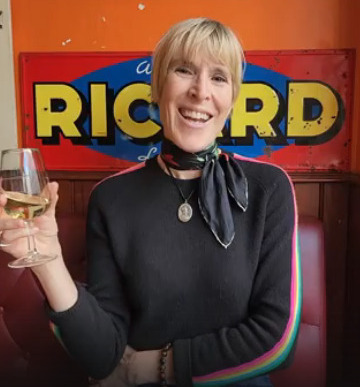 I hope to see you in October for The Paris Writers’ Café.
– Lisa
Lisa Pasold has led Paris walking tours for Classical Pursuits for more than 20 years. Her 2012 book Any Bright Horse was shortlisted for the Governor General’s Award for poetry. Her poetry and journalism have appeared in New American Writing, The Los Angeles Review, The Georgia Review, The Chicago Tribune, The National Post, and Billboard. She is creator of Improbable Walks, story-telling walks focusing on legends and place memory. She has created these art walks to critical acclaim for festivals and gallery residencies in cities such as New Orleans, Saskatoon, and Paris.
Image credits: Café Beaubourg terrace, Fred Romero/Wikimedia Commons
.jpg)