
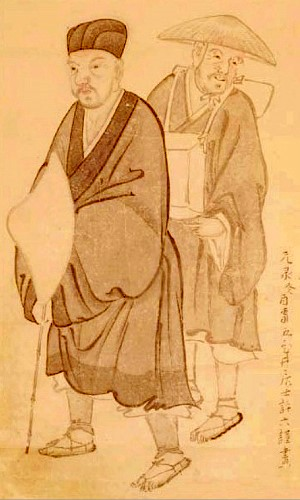
Early in Bashō’s collection of travel sketches The Narrow Road to the Deep North, he writes,
As I was plodding through the grass, I noticed a horse grazing by the roadside and a farmer cutting grass with a sickle. I asked him to do me the favor of lending me his horse. The farmer hesitated for a while, but finally, with a touch of sympathy in his face, he said to me, “There are hundreds of crossroads in the grass-moor. A stranger like you can easily go astray. This horse knows the way. You can send him back when he won’t go any further.”
When I first read this story, I found it fascinating and charming but I couldn’t have explained why. It seemed sort of like a spiritual parable and yet not. I probably could force it to be a set of wisdom instructions of the kind I’ve read in Buddhist texts or the Gospels, but what would be the point of translating it into something I’ve already encountered? Doing that would not help me understand why it spoke to me so powerfully. The passage has the quality of something being explained, but in a language I understood while I was dreaming and only half remember now. In other words, it feels like poetry.
My early education in poetry didn’t serve me all that well. Under pressure to standardize learning and treat everything as a competition, a tradition grew up of interpreting poems as if they were intended to be translated into abstract ideas and truisms such as, “Love is difficult but worthwhile.” It’s a position that can be defended easily in a five-paragraph essay.
By contrast, as I’ve seen over the years in seminars at Classical Pursuits, poetry has a way of unfolding—in ever greater complexity and beauty—rather than melting down when you handle it with respectful curiosity. I don’t know if I’ve ever read poetry as demanding and at the same time delicate as Bashō’s prose and haiku.
For example, our translator includes the following story in his introduction to The Narrow Road, which comes from a comment by one of Bashō’s disciples about his most famous haiku:
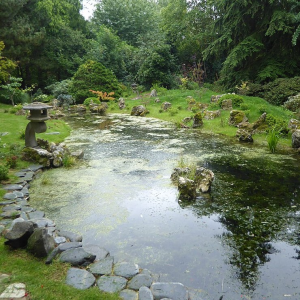 Breaking the silence
Of an ancient pond,
A frog jumped into water —
A deep resonance.
The disciple continues, “This poem was written by our master on a spring day. He was sitting in his riverside house in Edo, bending his ears to the soft cooing of a pigeon in the quiet rain. There was a mild wind in the air, and one or two petals of cherry blossom were falling gently to the ground. It was the kind of day you often have in late March – so perfect that you want it to last forever. Now and then in the garden was heard the sound of frogs jumping into the water. Our master was deeply immersed in meditation, but finally he came out with the second half of the poem…
“One of the disciples sitting with him immediately suggested for the first half of the poem,
Amidst the flowers
Of the yellow rose.
“Our master thought for a while, but finally he decided on
Breaking the silence
Of an ancient pond.
The disciple’s suggestion is admittedly picturesque and beautiful, but our master’s choice, being simpler, contains more truth in it. It is only he who has dug deep into the mystery of the universe that can choose a phrase like this.”
In our Toronto Pursuits 2026 seminar, Bashō the Pilgrim, we will allow Bashō’s writing to carry us wherever it will, trusting that it knows better than we do where we need to go.
— Rosemary
Image credits: Japanese gardens in Broadview Gardens, Kent/Marathon on Creative Commons; frog featured image, Flickr/Library of Congress; quote from The Narrow Road to the Deep North by Bashō, translated by Nobuyuki Yuasa, Penguin, 1967