
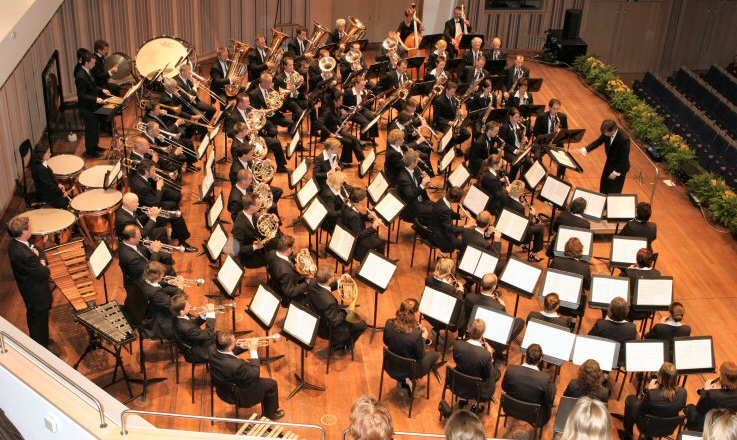
 A seminar series on the evolution of the symphony parallels a study of European history from the start of the 18th century to the present day. Enduring monarchy, aristocracy, democracy, socialism, fascism, communism and dictatorships – these are all reflected in some way in the broad range and scope of the symphony. In 1907, two great symphonic composers met and traded ideas and opinions about the symphony. The Finnish master Jean Sibelius (1865–1957) remarked to the Austro-German Gustav Mahler (1860–1911) that what he enjoyed most about the symphony was its logical structure and architecture, like nature.
You can detect this trait in the Sibelius symphonies by how he organically transforms small, simple building blocks of sound into a complex whole. But Mahler disagreed, replying, “No, a symphony must be like the world. It must embrace everything!” Mahler’s symphonies are philosophical musical essays that wrestle with the reasons for our existence, and life, death, and even life-after-death. I like to think that both Sibelius and Mahler were right. The symphony can be many things to many people, but in the end, it tells us about ourselves. To borrow from the name of a popular toy store chain, “Symphonies ‘R’ Us.”
The symphony evolved in the early 18th century out of earlier forms, including the Italian opera overture, the Baroque concerto grosso and the Baroque suite. At the time, it was largely a form of entertainment for the upper classes, who often maintained orchestras at court as a status symbol. For example, the Court in Mannheim along the Rhine River in Germany was very aware of the aristocratic status a crack orchestra could supply to any court. The onsite orchestra in Mannheim was so good that it was known across Europe as “an army of generals.” By the second half of the 18th century, F. J. Haydn, W. A. Mozart and others standardized the symphony into three or four movements with a variety of forms, speeds, styles, expressions and emotions. It grew in size, adding new instruments as they were developed, but it also grew in conception and scope, becoming, in effect, “a sonata for orchestra.”
After the French Revolution in 1789, and the sweeping social, political and cultural changes that resulted in Europe, the symphony evolved to the point where Beethoven (1770–1827) and others were capturing those changes in music. With the rise of a middle class in the 19th century, the symphony began to represent a broader slice of humanity and their realities, hopes and dreams. This continued into the 20th century, where composers often employed the symphony to capture the events and resulting feelings of the day, whether it be war, peace, devastation or triumph.
Today, the common format of a typical symphony orchestra concert tends to be an overture or short orchestral work to open, followed by a concerto featuring an international soloist. Then after intermission, the second half of the concert is often taken up with a symphony by one of the great composers. It’s a format that continues to work, building through the evening, with the “meat-and-potatoes” — the symphony — as the highlight at the end. Not only does the symphony offer the full range of human emotion, from love, happiness and joy, to anger, sorrow and grief, but it also reflects the beliefs, values and aspirations of a certain period, a nation or nationality, or specific historical circumstances. Like other great art forms, it reflects the human experience, or life itself. Join me at Toronto Pursuits in July 2026 for A Symphonic Symposium – Sources, Symptoms and Solutions, a fascinating and stimulating journey through the history and evolution of the symphony.