
When I moved to New Delhi/Gurgaon in 2007, I quickly learned I had arrived in many cities at once: imperial Delhi and democratic Delhi, Mughal Delhi, mall Delhi and office park Delhi, Delhi of gardens and Delhi of traffic, Delhi of ghosts and Delhi of call centres. During those years, evenings and weekends spent in the Indian capital’s art galleries, movie theatres, markets, and restaurants became my informal education.
As did books—browsing the used book stalls with friends or relaxing outside with a new novel on a mild January Sunday remain some of my best memories of my life in India. Friends and colleagues were constantly trading recommendations and holding book swaps; it was an exhilarating crash course in modern and contemporary Indian fiction. One friend from Toronto even decided to do a PhD in this field when she returned to Canada.
That is why I love reading before travelling to India. A good novel does not simplify the country for us. It gives us a way to sit with its vast scope and its contradictions.
On our Literary India tour in January 2027, we will travel the Delhi–Jaipur–Agra route, spending several days in and around Delhi before continuing to Rajasthan, Fatehpur Sikri, and Agra. We will discuss Midnight’s Children; visit Old Delhi, Humayun’s Tomb, the Lodhi Art District, Jaipur, the Jaipur Literature Festival, Fatehpur Sikri, and the Taj Mahal at sunrise; and talk about what the books let us see once we are actually standing there.
Midnight’s Children is an undisputed classic. But there are other books I would love readers to have in mind too. Four of these I have read; one, Karan Mahajan’s The Complex, I have just started. Together, they form a kind of unofficial shelf for north India: border, capital, catastrophe, night shift, family compound.
Train to Pakistan, by Khushwant Singh
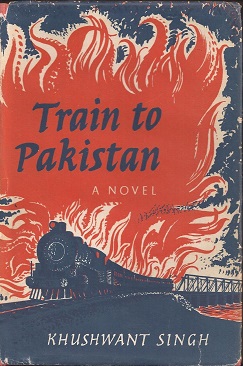 Begin not in Delhi, but at the edge of a new border.
It is hard to think seriously about north India without thinking about Partition, and Khushwant Singh’s Train to Pakistan (1956). The novel is set in Mano Majra, a fictional village where Sikhs and Muslims have lived together for generations. The overall peace they share is broken when a train arrives carrying the bodies of refugees, bringing the violence of Partition directly into village life.
This is a devastating book, and a deeply humane one. It is useful before travelling to north India because it shows the forces that are unleashed by decisions made in capitals and parliaments. The consequences of misunderstanding and of wielding power in a certain way arrive in railway stations, in village squares. These forces change how neighbours look at one another. They shape love stories, daily routines, jokes, silences, and fear.
On the tour, we will spend time in Delhi thinking about modern India: along ceremonial roads, at monuments, in museums, and in conversation around Midnight’s Children. Train to Pakistan gives another angle on independence: not the birth of the nation as celebration, but the human consequences of drawing a line across lives.
Read this before Delhi not because the book is about Delhi, but because it steadies the conversation we will be having while reading Midnight’s Children: how nations are imagined and by who, and what that imagining costs individual lives.
Delhi, by Khushwant Singh
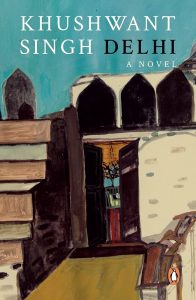 If Train to Pakistan compresses history into one village, Delhi sprawls.
Khushwant Singh’s Delhi (1990) is irreverent, even rude. It’s excessive, and in many places deliberately outrageous. It’s like Delhi itself on a hot afternoon: crowded, argumentative, funny, infuriating, and alive. As the plot moves between the narrator’s present day and the history of Delhi through the Raj and independence, we encounter the “poets and princes, saints and sultans, temptresses and traitors, emperors and eunuchs” and their millions of deeds and misdeeds that shaped the city.
This is the book I would recommend to anyone who wants to truly feel Delhi as a palimpsest. The narrator’s love for this city that refuses to be contained is infectious. On our first days of the tour, we move from the narrow streets of Old Delhi and Chandni Chowk to Jama Masjid and the Red Fort; from Humayun’s Tomb to the Lodhi Art District and Qutab Minar; from the ceremonial roads of Janpath and Rajpath to the National Museum.
A conventional guidebook can tell you what was built, by whom, and when. Singh’s novel asks a more unruly question: What if a city is not one history, but many histories competing for breath?
A note for readers: Delhi is not gentle. Its sexual politics, language, and narrator will not be for everyone. But as an imaginative encounter with Delhi’s long memory, it has a force that is hard to shake.
Animal’s People, by Indra Sinha
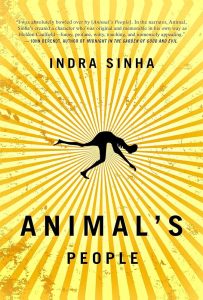 Strictly speaking, Animal’s People (2007) takes us away from the Delhi–Jaipur–Agra route and into the fictional city of Khaufpur. But I include it here because it asks a question every thoughtful traveller to India has to face in some form: Who gets to tell the story of suffering? Who even decides what suffering is?
Indra Sinha’s novel is narrated by Animal, a 17-year-old whose body was permanently altered by a chemical disaster in Khaufpur (a stand-in for the real-life 1984 Bhopal disaster) when he was an infant. Because of his twisted spine, Animal moves on both arms and legs. He’s a street-smart fast talker who looks after the ancient French nun Ma Franci and really, really wants to get laid.
He finds himself an unlikely ally (fremeny?) to an American doctor who has come to open a free clinic to serve the people injured by the distance. Not surprisingly, they don’t initially trust her and, also no surprise, she doesn’t fully understand why they wouldn’t. The surprise of the novel is Animal’s voice: angry, comic, obscene, and tender. The book refuses the comfortable distance that often creeps into stories about disaster. Animal rejects the sympathy and pity these stories can evoke and asks the reader for something more of themselves.
Why read it before north India? Because the very real material differences between your life and that of many of the people you will meet in India can feel like a gulf that is hard to bridge. Animal suggests a different way across than conventional sympathy. Animal’s People belongs on this shelf because it keeps the ethical imagination awake.
One Night @ the Call Center, by Chetan Bhagat
 After Partition, empires, and catastrophe, you may be ready for a lighter read, and I’ve got a pop classic for you here.
Chetan Bhagat’s One Night @ the Call Center (2005) is a very different kind of novel: fast, comic, pop-cultural, and contemporary. It’s story of six friends working nights at a call center, providing technical support for a major American appliance corporation. They’re in Gurgaon the city where I lived on the border of Delhi and the state of Haryana and a place reshaped entirely by outsourcing. Behind the customer-service scripts, the friends’ personal lives are unravelling just as fast as the malls of Gurgaon are popping up.
For many readers outside India, the country first appears in the imagination through ancient temples, Mughal tombs, epics, spirituality, or colonial history. Those are real parts of the story. But so are outsourcing, start-ups, night shifts, American accents, office politics, bad bosses, young professionals, ambition, romance, and exasperation.
Bhagat’s novel gives us the India of fluorescent lighting and global capitalism. It is a useful counterweight to the forts and mausoleums, and to the ideas of tradition that can take up a lot of space in our thoughts about what India is. We will visit places shaped by Mughal emperors and Rajput rulers; One Night @ the Call Center show us the role that India’s huge population of young professionals play in shaping the country and invites us to share in their petty squabbles, true friendships, and their hopes for themselves as they try to make a life.
The Complex, by Karan Mahajan
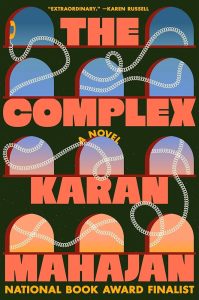 The final book on my list is the one I have only just started, so I offer this recommendation with a new reader’s enthusiasm rather than a more formed idea of why you should read this book.
Karan Mahajan’s The Complex (2026) is the story of the Chopras, a prominent Delhi family living in a sprawling apartment complex. Their lives are governed by this physical proximity and by the shadow of the late family scion, S.P. The novel’s world includes family legacy, real estate, political ambition, betrayal, love, and the pressures of a changing nation.
That premise alone makes it irresistible for our purposes. Delhi is not only a city of monuments. It is also a city of compounds, colonies, apartment blocks, family negotiations, status anxieties, political arguments, and private rooms where public history gets absorbed into domestic life.
I am especially interested in reading The Complex alongside Singh’s Delhi. Singh gives us the city across centuries; Mahajan appears to give us Delhi through the architecture of family and power. One moves by historical sweep, the other through inheritance, ambition, and decay. Both suggest that Delhi is never merely a backdrop. It acts on people. It pulls them back. It makes claims.
What These Books Give Us
Together, these five novels make a map.
Train to Pakistan takes us to the border village and the wound of Partition. Delhi plunges us into the capital’s unruly, many-layered past. Animal’s People asks us to listen to a voice shaped by disaster but not reduced to an outsider’s idea of victimhood. One Night @ the Call Center moves us into the world of globalized work and late-night reinvention. The Complex brings us back to Delhi through family, property, ambition, and politics.
None of them explains India. Thank goodness. Together, they do something better. They make us read the itinerary less like a checklist of sites to see or experiences to have, and more like a way to be present in India, and see what it shows you.
Who gets remembered? Who gets displaced? Who speaks? Who profits? Who falls in love anyway? Who is on the phone at three in the morning trying to survive a shift?
That is the kind of travel I want for Classical Pursuits. We will have our planned seminars, our guides, our literary discussions; we will have time for chai, jalebi, markets, murals, perhaps a tiger (no promises), and the sunrise that does do what photographs promise. But my hope is that these activities will just be a way in to your own understanding of India, which cannot be planned but only lived.
So choose the book that calls to you. If you want a short, piercing classic, begin with Train to Pakistan. If you want the whole messy theatre of Delhi, try Delhi. If you want a furious, unforgettable narrator, read Animal’s People. If you want something quick and contemporary, go with One Night @ the Call Center. And if you want a brand-new family saga rooted in Delhi’s modern transformations, join me in starting The Complex.
Bring Midnight’s Children, because that is the official reading. But tuck one of these in too. Then let it make the road less simple on our January 2027 tour.
I hope to see you in New Delhi next winter!
— Melanie
Featured image credit: Alan Morgan on Flickr