
This is the second of a three-part series on our favourite writing cafés in Paris.
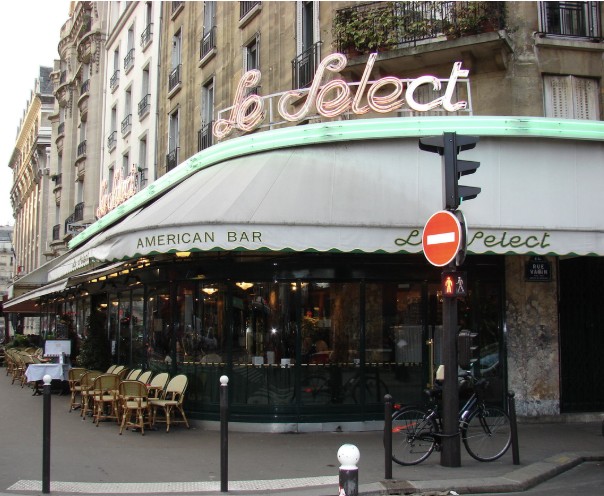
There are a slew of historic cafés along the famous Boulevard Montparnasse, and my favourite of them, Le Select, recently celebrated its 100th anniversary. From the moment it opened in the 1920s, this café was beloved not only by visiting anglo writers like Ernest Hemingway and Morley Callaghan, but was also popular with Surrealist writers like André Breton and Elsa Triolet. Later, Beat poets like Allen Ginsberg adopted the place—Ginsberg wrote “I sit weeping in the Café Select … I have to get up a rhythm to cry.”* New Wave filmmakers like Jean-Louis Godard also made this particular café his local.
Fortunately for us, today, the century hasn’t brought serious change to Le Select’s ambiance. Traditional Parisian café society is still going strong: Le Select opens its doors at 7 a.m. and closes after midnight, seven nights a week. The café appears in French-Algerian writer Leïla Sebbar and Canadian writer Nancy Huston’s book, Lettres parisiennes—both women have lived their adult lives in Paris and both write in French; their friendly letters are an insightful short read. Sebbar is a café addict: she loves to spend time at the comptoir, observing people. In this tiny excerpt (my translation), Sebbar is writing to Huston from Le Select on May 11, 1983: “I like writing in cafés, in brasseries, especially in the empty hours of the morning and the afternoon, when the waiters trail about or doze. I ask for paper. If it’s a grand brasserie they give me letterhead paper… [and] if I can’t get paper from the waiter, with or without letterhead, it’s a bit of the tablecloth, the sugar packets, the back of the bill—which is never enough space.”
Her habit reminds me of the behaviour of American writer Henry Miller in the 1930s. His lover, the writer Anaïs Nin, described how he would write feverishly on any bit of paper he could reach, collecting wine labels and torn bits of bills and shoving them into his pockets, to type up later. Miller spent lurking in the Montparnasse cafés, hoping a wealthy patron would buy him a drink.
The Paris café has never really been about the coffee, per se, though Monsieur Select, in 1925, was famous for roasting his own beans. But even then, Le Select became known for its “American bar”. With Prohibition in the US, café owners of the 1920s were amazed and appreciative for the amount of money Americans spent on cocktails. The Select was not the only café to advertise their “American bar”, i.e., cocktails, on the awning, facing onto the boulevard.
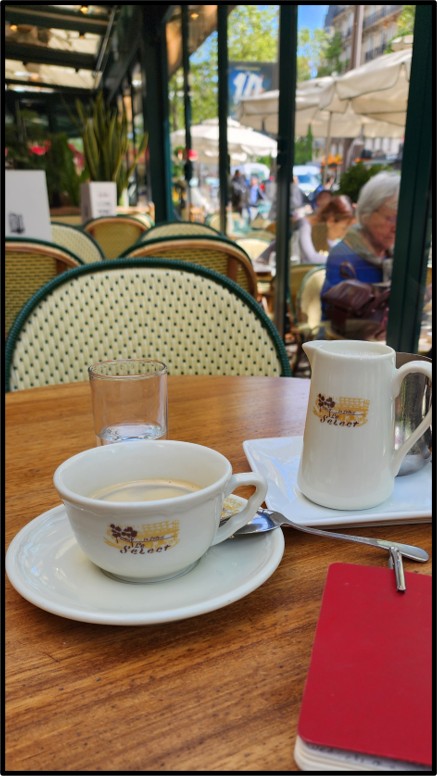
As some readers here already know, my daily routine in Paris relies heavily on the café. I write, read, and meet friends in a variety of cafés across the city. This coming October, I’ll be leading a tour with Melanie that explores the creative energy that comes from working in such inspiring Parisian places—including the Select.
For most of my life, Le Select was run by the Plégat family. The café cat, Mickey, was a familiar figure. But a few years ago, Mickey passed, and the family sold the café. Fortunately, to everyone’s relief, not much has changed. I especially enjoy the glass-covered terrace in the afternoons, where even the tiniest bit of sunlight will catch the café tables. Today, in the Select, I am careful to tuck my feet out of the way, so I don’t trip the waiter. In winter, I always order hot coffee. But today it’s a lovely spring day, and when the waiter comes by, impeccable in his traditional black vest, white shirt, and white tablecloth apron, I ask for a kir.
Crème de cassis (which is very sweet blackcurrant liqueur) has been drunk in Burgundy since the 1700s; in 1841, a café owner created a version that was stable enough to be made in a factory and mass produced. Of course it was a café owner who came up with mass-produced crème de cassis! They understand what the public might want to drink!
But the drink really became popular in the 20th century, and there are a number of stories about its political debut: the Café Montchapet in Dijon claimed that a waiter decided to improve the sour, cheap bourgogne aligoté with a shot of sweet crème de cassis, back in 1904. The mayor of Dijon had one in the café and began serving the drink to visitors. But the drink is formally named for Felix Kir, an active member of the French Resistance during World War II. The region of Burgundy was famous for its Resistance to the Nazis, and Kir was mayor of Dijon from 1945 to 1968. He allowed Dijon liqueur companies to put his name on their crème de cassis bottles, in order to promote products form the region.
These days, you might have a Kir royal if you’re feeling festive—that’s a kir made with champagne instead of bourgogne aligoté. Beware if a waiter offers to “improve” your classic cassis by making it “royal”—it’ll be twice the price. And you may also be offered a selection of fruit liquors to flavor the drink—not just cassis (the original blackcurrant) but also peach and blackberry. I stick to the classic original, myself.
At first, the proportions were roughly 1/3 crème de cassis to 2/3 bourgogne aligoté, but these days it’s more like 1/5 kir to 4/5 white wine. The classic kir is inexpensive, and a joy to sip on the terrasse of the Select.
I love the history of these formal Montparnasse cafés, still patronized by such a mix of people. Every now and then, some students walk by, and I think of a coffee I drank in Kyrgyzstan a few years ago. Near the border with China, we stayed in a yurt on the old Silk Road. I talked with the young man who ran the yurts—he herded yaks for a living. However, his older sister was studying international politics at the Sorbonne, in Paris. Sometimes when I sit on the terrasse of the Select, I wonder which café she is in, even now, planning and talking and studying. Because all across this city, the next wave of writers and artists and politicians and world-changers are talking and writing and sipping their drinks, right this minute. Who knows, maybe I’ll see you here, too.
– Lisa Pasold
*note, this Ginsberg quote is from memory. The book I pulled it from is unfortunately on the wrong side of the Atlantic from me, while I’m writing this.
Next up, Lisa’s favourite dive café in northern Paris.
 Lisa Pasold has led Paris walking tours for Classical Pursuits for more than 20 years. Her 2012 book Any Bright Horse was shortlisted for the Governor General’s Award for poetry. Her poetry and journalism have appeared in New American Writing, The Los Angeles Review, The Georgia Review, The Chicago Tribune, The National Post, and Billboard. She is creator of Improbable Walks, story-telling walks focusing on legends and place memory. She has created these art walks to critical acclaim for festivals and gallery residencies in cities such as New Orleans, Saskatoon, and Paris.